
A timeline of the key events in the 2006 Mumbai train blasts case, culminating in the acquittal of all 12 accused by the Bombay High Court.
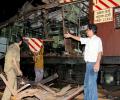
The Supreme Court has stayed the Bombay High Court verdict acquitting all 12 accused in the 2006 Mumbai train bomb blasts case, issuing notices and seeking responses from the accused.

Survivors of the 2006 Mumbai train blasts express shock and disappointment after the Bombay High Court acquitted all 12 accused, citing lack of evidence. They feel justice has not been served after 19 years.
The Bombay High Court has repeatedly flagged the 'copy-paste' culture in confessional and witness statements in chargesheets, calling it a 'dangerous' trend. This issue was highlighted again after the acquittal of the 2006 Mumbai train blasts accused, with the court noting similarities in their confessional statements.

Twelve persons, arrested in 2006 for their involvement in the July 11, 2006 serial train blasts case, were acquitted by the Bombay high court on Monday.
'No one got punished for the irreparable damage and pain suffered by thousands of families'

The pain in Priti Sawant's eyes is heart-wrenching, but her belief that her husband will rise from that hospital bed is a lesson in courage.

The 'record speed' in which the 26/11 probe was conducted may have set a precedent for future terror cases, but why does one forget the July 2006 train blasts which killed 187 innocenct persons travelling in the local trains of Mumbai?
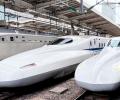
Railway Minister Ashwini Vaishnaw will inaugurate the underground tunnel-boring work from Vikhroli to the Bandra Kurla Complex station in Mumbai on Sunday, marking the maiden use of a tunnel boring machine for the country's first bullet train project, between Mumbai and Ahmedabad.

Seventeen years since a string of powerful bombs ripped through Mumbai's commuter trains system in the evening rush hour on July 11, the Bombay high court is yet to commence hearing on the confirmation of the death penalty given to five convicts in the case.
In his applications filed before the National Human Rights Commission as well as Maharashtra State Human Rights Commission on Friday, Abdul Wahid Shaikh also requested support for rehabilitation.

Avinash Arun's Prahaar: The Untold Story of Ujjwal Nikam emerges as a rare honest film in contemporary Bollywood, skillfully navigating the sensitive narrative of the 26/11 Mumbai terror attacks and the prosecution of Ajmal Kasab without succumbing to propaganda, observes Prasanna D Zore.
Aatib Nasir Mullah, a resident of Padgha village in Thane district, was arrested near the Bandra-Kurla complex.
Nineteen years later, remembering how terror struck Mumbai's lifeline on July 11, 2006.

The Mumbai-Ahmedabad bullet train project has achieved a significant milestone with the excavation of a mountain tunnel in Palghar, Maharashtra, marking the third such achievement in the district within the last five months. This progress underscores the rapid construction pace in a geographically challenging section of the high-speed rail corridor.

'I had narrated a script to Nana Patekar, and four days before the end, he told me that once he returned from Goa, he would take the project forward. I still can't believe he is never coming back. He was always so fit, proudly flexing his muscles and urging me to work out.'

Special Public Prosecutor Raja Thakare said that he would not pray for death at all.

Pronouncing the verdict, the special Maharashtra Control of Organised Crime Act (MCOCA) court judge Yatin Shinde sentenced to death Faisal Sheikh, Asif Khan, Kamal Ansari, Ehtesham Sidduqui and Naveed Khan who planted the bombs in various trains.

The Gujarat high court has characterised the 2008 Ahmedabad serial bomb blasts as a direct assault on India's sovereignty and democratic governance.
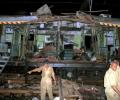
Seven years after the Mumbai serial train blasts in which nearly 200 people were killed and over 700 injured, the trial in the case is still going on with the special Maharashtra Control of Organised Crime Act court recording the statements of the accused. "The court is now recording the statement of the accused who wanted to depose as a defence witness in the case," said advocate Sherif Sheikh, appearing for some of the accused in the case
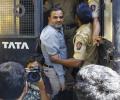
On Wednesday, the special MCOCA court in Mumbai awarded death sentences to Kamal Ahamed Ansari, 37, Mohd Faisal Shaikh, 36, Ehtesham Siddiqui, 30, Naveed Hussain Khan, 30 and Asif Khan, 38, for the role they played in the 7/11 Mumbai train blasts, which claimed the lives of 188 people.

Family members of Kamal Ahmad Vakil Ahmad Ansari, who died awaiting justice in the 2006 Mumbai train blasts case, read aloud the Bombay High Court's acquittal order at his grave, publicly affirming his innocence and demanding accountability from the system.

In a move that may leave the police and Maharashtra government red-faced, an accused in the July 2006 Mumbai train blasts case has come up with information through RTI to show that some prosecution witnesses were lying, and some of them were facing criminal cases themselves.
Safdar Nagori, the general secretary of the proscribed outfit Student's Islamic Movement of India, was in Mumbai on July 11, 2006, when a series of explosions in suburban trains claimed 187 lives and injured thousands. Nagori is said to be acquainted with serial train blasts case accused and SIMI's Maharashtra unit general secretary Ehtesham Siddiqui. However, investigators have not been able to establish any link between Nagori and the serial blasts.
In a breather for the Maharashtra ATS, arrested Yasin Bhatkal has confirmed to his interrogators that Gujaratis travelling in first class compartments of Mumbai locals were the target of 2006 train bombings as the IM wanted to avenge the 2002 Gujarat riots. Vicky Nanjappa reports.
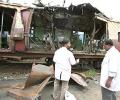
Nine years after seven RDX bombs kept in Mumbai suburban trains exploded killing 188 people, a Special Maharashtra Control of Organised Crime Act court is likely to pronounce its verdict on Friday.

A fire broke out in huts near the Harbour line tracks in Mumbai's Dharavi area, leading to temporary suspension of train services. No injuries were reported.

Shivam Dube, fresh from winning the T20 World Cup, had to take a train home to Mumbai due to fully booked flights, disguising himself to avoid attention.

The case took a twist when the defence lawyer sought to call Indian Mujahideen co-founder Sadiq Sheikh as a defence witness after he told the police in 2008 that IM members were responsible for all the blasts that had occurred in India since 2005 including the July 11, 2006 train blasts.

A 4.88 km tunnel between Shilphata and Ghansoli for the Mumbai-Ahmedabad bullet train project achieved a breakthrough, marking a significant milestone in the project's construction.
The special Maharashtra Control of Organised Crime Act court in Mumbai on Saturday passed an order prohibiting the media from publishing anything pertaining to investigations in the serial train blasts here in July 2007.

Debutant Aman Indra Kumar simply has no screen presence or charisma, sighs Mayur Sanap.
Former Mumbai police commissioner A N Roy expressed shock over the Bombay High Court's acquittal of all 12 accused in the 7/11 train blasts case, defending the police investigation and expressing confidence in an appeal to the Supreme Court.
Pakistan Foreign Minister Shah Mehmood Qureshi was on Tuesday quoted as having linked the Samjhauta train blasts near Panipat in 2007 to the Mumbai terror attacks last November.According to the Dawn newspaper, Qureshi had told reporters in Multan that the Samjhauta Express incident and the Mumbai attacks were inter-connected and the probe could continue only if India responds to questions raised by Pakistan.
Nearly four years after the 7/11 serial train blasts, the trial in the case is all set to resume on Monday in a special court in Mumbai against 13 arrested accused, alleged to be members of the banned terror outfit Students Islamic Movement of India. The Supreme Court had in February 2008 stayed the trial after one of the accused, Kamal Ansari, approached the court challenging the constitutional validity of a particular section pertaining to insurgency in the MCOCA.
The Bombay High Court acquitted all 12 accused in the 2006 Mumbai train blasts case, citing a failure by the prosecution to prove their guilt and raising serious concerns about the investigation and evidence presented.

The Hitman still probably hurts over missing World Cup glory in 2011 and his stellar career rightfully deserves one last hurrah at the ODI World Cup.
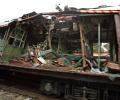
The blame must be shared by the investigating agencies, the government of the day and the nation at large, points out Colonel Anil A Athale (retd).
